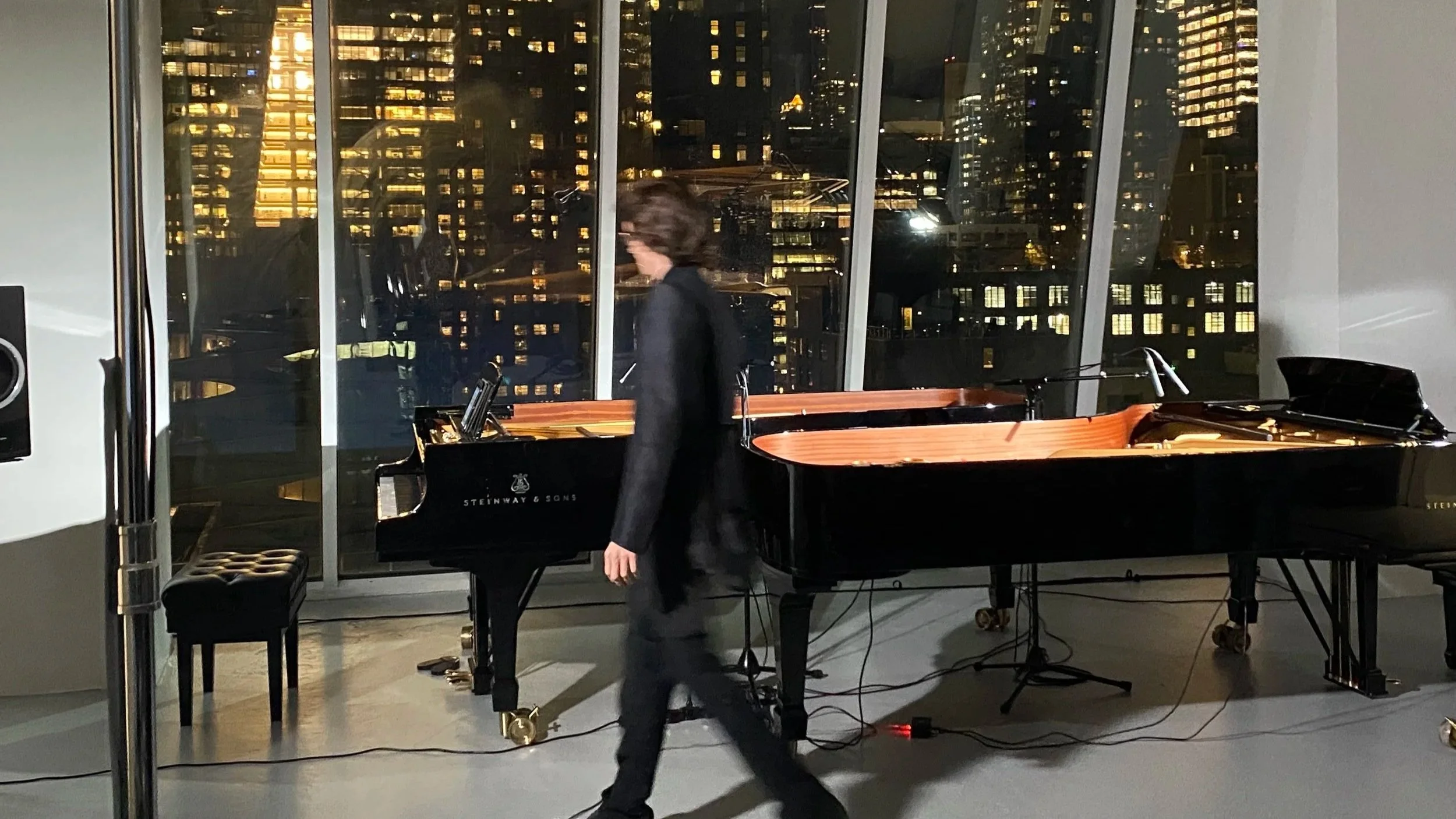
get used to it man thats the way we live now
Composer Notes
To begin with the title: get used to it man thats the way we live now
Some five years after Kevin and I began our collaboration at Qualcomm Institute / UC San Diego –– he on the electronics side, me on the compositional –– we both had returned to New York City full time, where we set up a studio of our own design. Year after year we continued to experiment, inevitably rejecting most of what we tried out. The only reliable constant was that on Saturdays we took lunch at 2pm. Returning to the studio one particular afternoon, I saw a young man approaching looking only at his phone, oblivious to anything else. Nowadays that is the most unremarkable event imaginable. But in 2015 it was still a novelty. From a distance I looked at him with an expression of, "Dude, at what point do you realize you are going to walk straight into us?" But he kept coming, never looking up. Only at the last possible moment did he take one small step to his right. At the moment we passed each other, he calmly uttered the words now memorialized as the title.
The relevance of that comment to our mission seems to me even clearer now than it did then. It originates with an actual event –– what someone expresses at a particular moment that manages to embrace both the instant context and a larger meaning.
The piece is in three parts, written at widely separated times: Part one ("Imaginary Themes") in 1986, part two ("It is written") in 2018-19, part three ("The Revelation of Dreams") in 2026. The common link is that they are all interpretations that derive from the same "sketch" - somewhat as if an artist returned to the same landscape years later to paint new interpretations of the view.
As it unfolds over the course of a concert-length presentation, the work is indeed meant to illuminate Currawong Project's many aspirations. Above all, we want to offer a very new form of dynamic interaction between performer and technology: Sound transformation as the product of virtuosity, yet largely beyond the conscious control of the performer. We revere virtuosity -- but not merely as the glorious gift composers and listeners alike are always grateful for. We engage virtuosity as a generative force intrinsic to the composition itself.
To illuminate further, let me start with this: We use computers for two distinct purposes. The first is for what we might think of as its "traditional" role in music: extending the available sound world beyond what humans playing instruments alone can produce. The second, which has only become viable very recently, is to analyze qualities and details of the interpreters' performances at a level deeper than we humans can consciously identify.
In our work, these two applications are interrelated. Here I’ll get into the weeds a bit: Kevin created a matrix of sound transformations –– we call them dynamic transforms –– that modify the sound of the piano at the moment hammers strike the strings. Some of these are subtly different from others, most are substantially different. But neither are these transforms fixed in timbre, as the nature of the transformation depends very much on how the keys are struck. They are particularly reactive to varying dynamic levels.
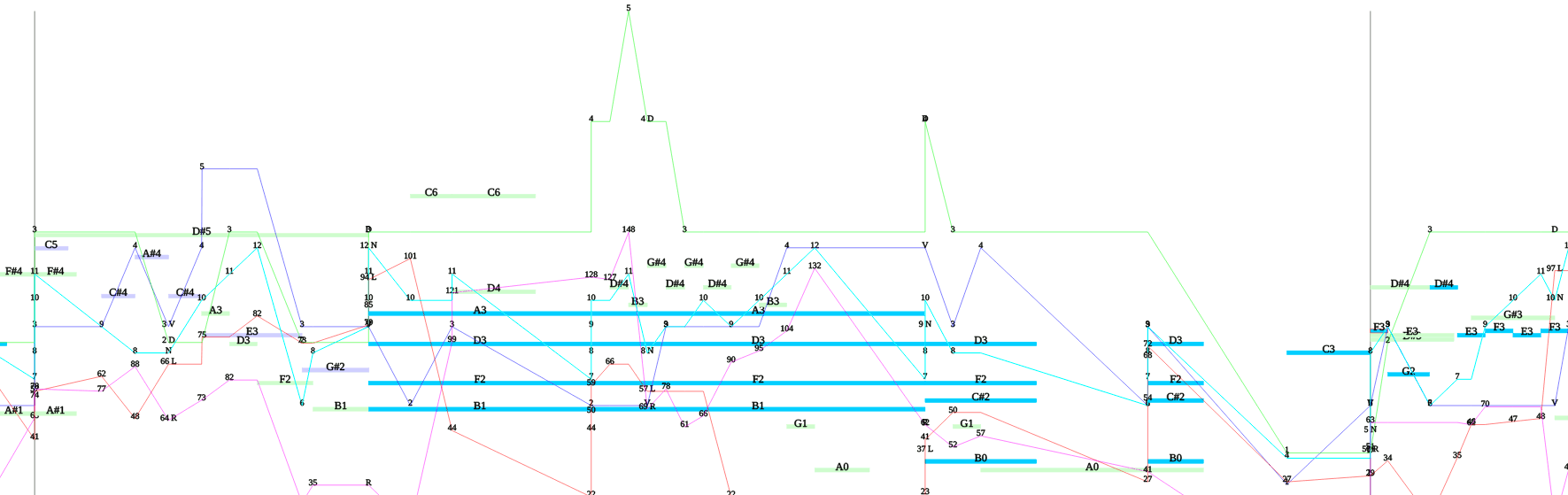
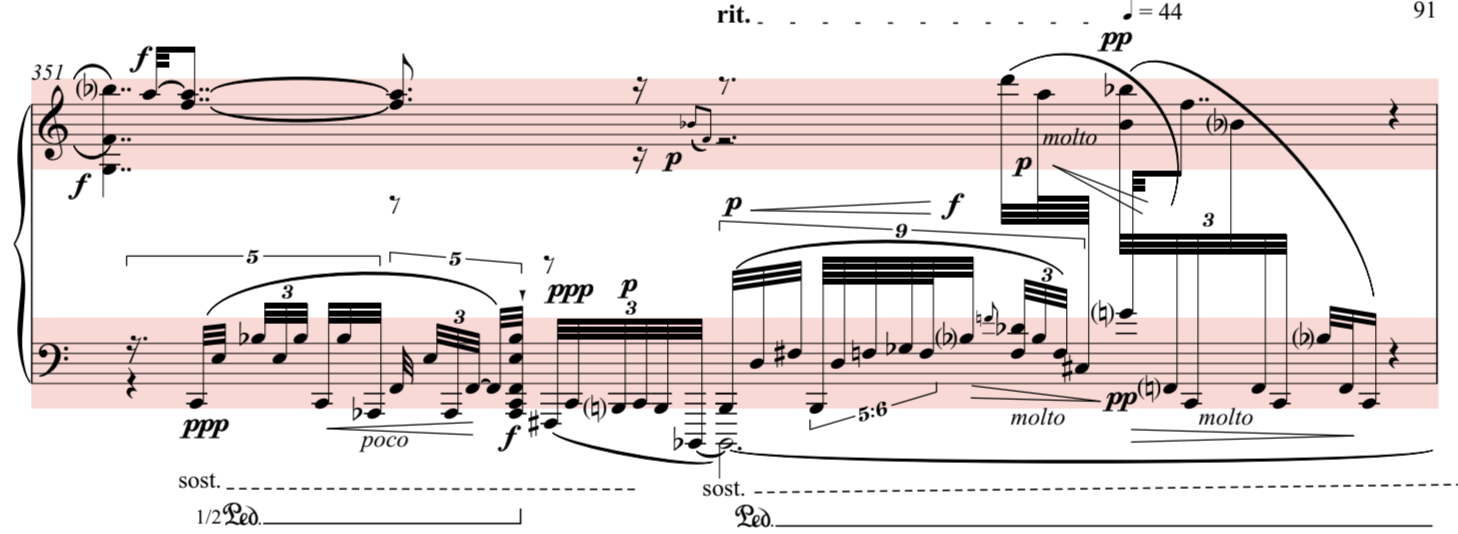
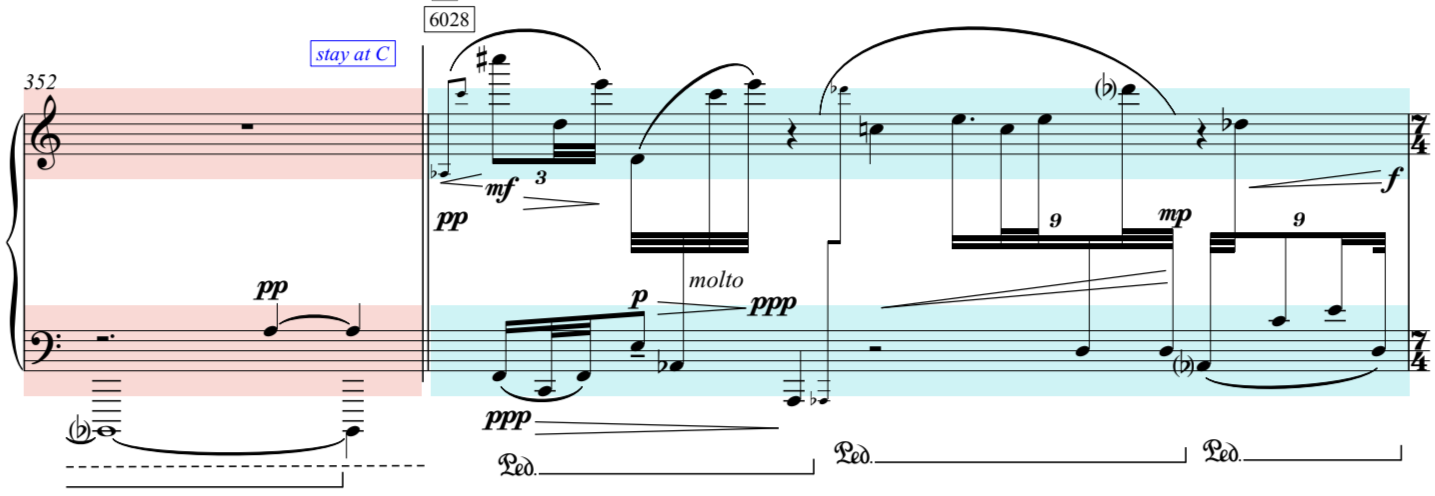
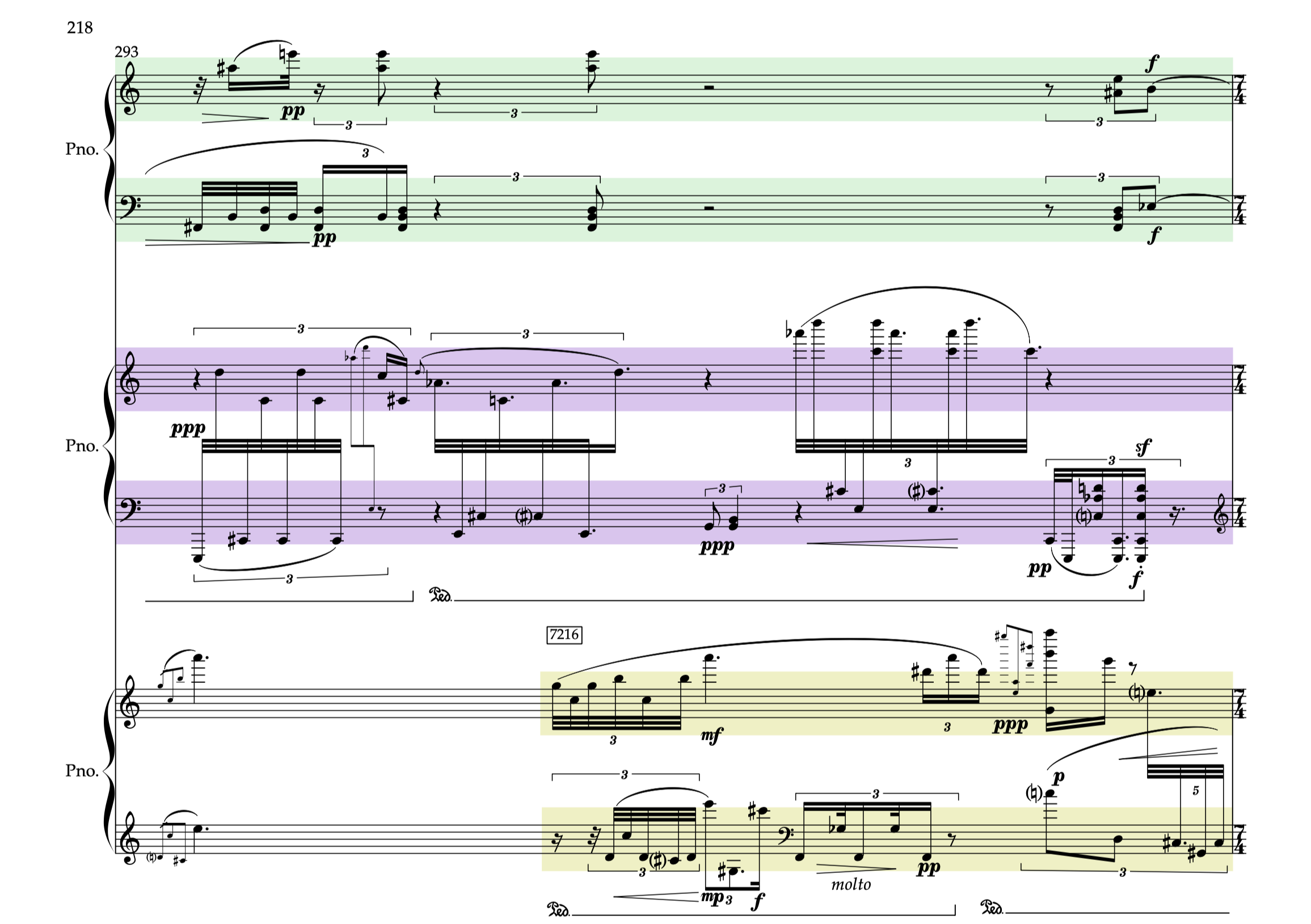
So to begin with, I applied one or more possible transforms – or in some cases no transform at all – to hundreds of moments in the score, some as brief as a single note, others as long as an entire phrase. (In fact, chords can have transforms assigned to individual notes.) We think of these as transforms assigned at a primary level.
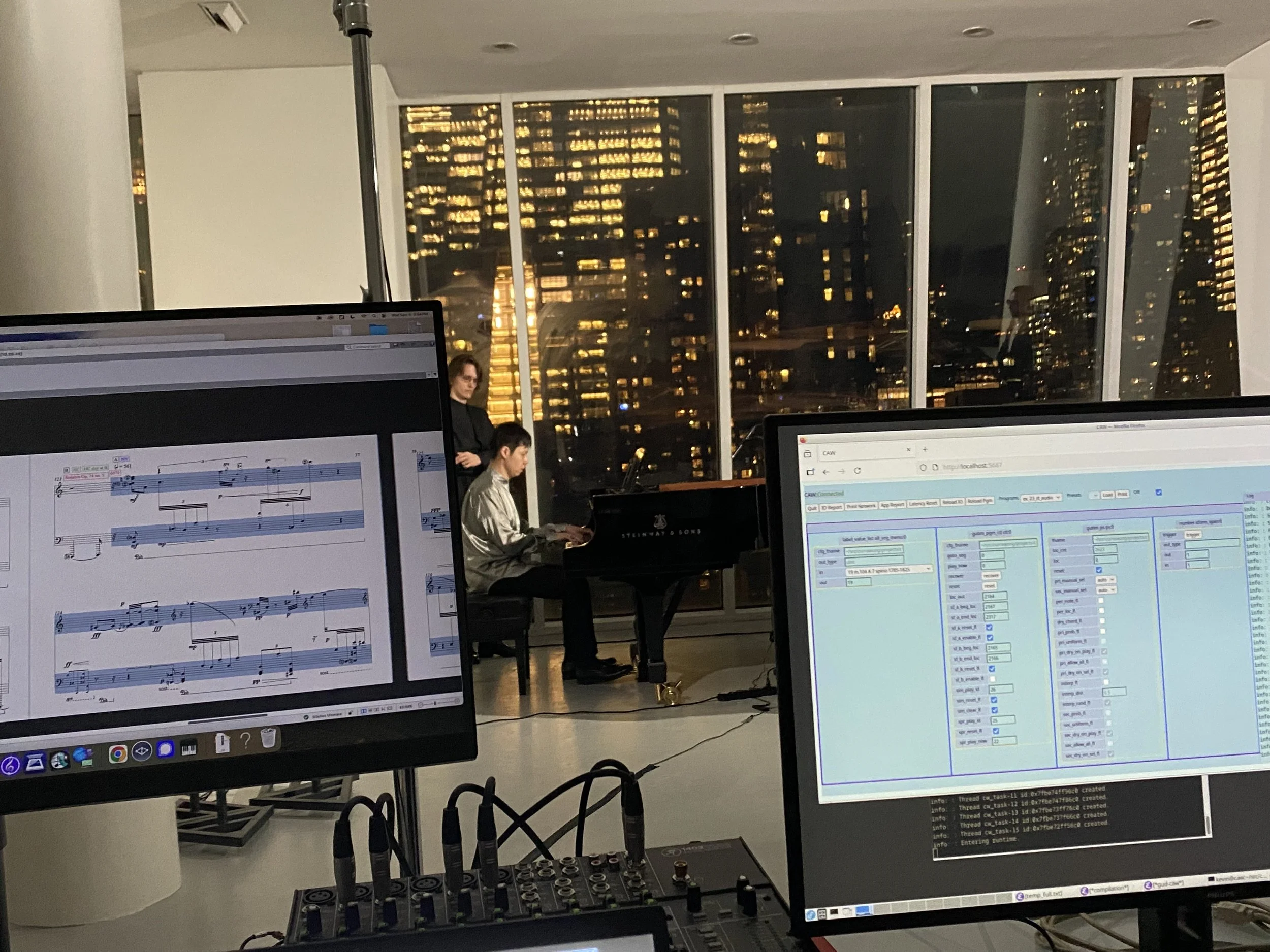
Then, during performance, the second role of the computer comes into play. Now it is no longer only producing sound, but analyzing performance in real time, and applying what is most salient to the quality of performance and performer identity to a shading, or fine tuning, of the sound of our transforms.
We think the term ”dynamic transforms” to be highly descriptive, in that dynamics in the musical meaning of the word, and dynamic in the sense of being responsive to immediate events, are both applicable.
What the audience hears out of the speakers is a combination of (1) transforms that first I assigned (or weighted as possible alternatives) entirely on the basis of what sounded good to me, and (2) real time performance analysis that we don't weigh in on whatsoever. The electronic sounds are always a product of both, in varying ratios. There is just one consistency: All electronic sounds are solely derived from sound that originates with the piano.
What does Scriabin have to do with any of this?
I’ll try to answer the question by noting that from time to time music – in fact, all the arts – go through a period of substantial transformation as the product of radical experimentation. Nowadays we think of the world as transformed every 15 minutes. There’s a lot to be said for that view. But a truly transformative moment – sticking to the arts here – is the upshot of a certain community of artists working with some degree of common understanding of the definitions of a newly emerging aesthetic. That may well not be so today, but it was arguably the case in the years preceding and into the outset of World War 1 –– if not for all artists, in retrospect at least for a critical mass. In the last years of Scriabin’s tragically cut short life, he produced piano music that even today, more than a hundred years later, resonates as radical, experimental –– as if he were reaching for something not yet known.
Such moments of instability resonate strongly with me. In the first few decades of the 20th century tonality as an overriding principle was no longer presumed, yet no one had established any definitive, agreed organizing principle –– at least none that more than one composer could subscribe to. When we hear music from that period of uncertainty, of transition, it still seems to be full of promise. The directions music eventually followed were not, to my mind, inevitable nor the most fulfilling.
I like to imagine I share an affinity for engagement with the unknown, and too that as innovative and responsive to “the way we live now” this composition seeks to be, there is an irreplaceable context and meaning to be found by reflecting on piano music from another era that also sought to express the world as the composer found it to be at that moment. Alexander Scriabin's late piano works are to my ear bright, shining examples of an exploration of what, a little more than 100 years ago, a new aesthetic might sound like. It's no accident that these works are short –– they are arguably expositions without the possibility of development. In an effort to make the synergy between these works and my own musical interests more apparent, we hit upon what we hope listeners will find an intriguing presentation: Over the course of my 38-minute piece, periodically interpolating –– attacca, without warning –– 10 highly succinct Scriabin works.
Safe to say, all of the pianists participating have their own affinity and performance history with Scriabin's music. I hope therefore that the immediate proximity of Scriabin's abstract works to my piece in this presentation design might further inform their performances of my score.
I’ll close with one other observation about the music Kevin and I collaborated on that is central to our interest, and that we hope gives meaning to the work. We call our practice dynamic music not only because it evolves responsively to performance analysis, but because of the central role played by calling for the broadest possible spectrum of dynamic levels, from barely perceptible to chillingly loud. And often with many dynamic levels coexisting at the same moment, such that certain soft tones act more as "coloring agents" for the more prominent ones. Great performers are able to deliver highly distinct dynamics with astonishing precision, and the human ear is perfectly capable of hearing very soft, very loud, and many layers in between all at the same time –– with astonishing clarity. My own view is that dynamic contrast, range and fine calibration are an essential resource and dimension available to composers, yet rarely taken full advantage of. Let’s not forget also that speakers are not only useful for amplification – they are pretty good at delivering breathtakingly quiet sounds just as well.
We would like to express our profound thanks to the many people and support structure made available to Kevin and me who were connected with UCSD’s Qualcomm Institute in our first years of work there. By affording us the time and space to experiment and iterate without asking anything of us, it became possible for us to take a very long view, and thereby set us on a path to pursue what it is we continue to hope to achieve.
– MK